
 Spotted by Ilse and by Ian Wright: uploading with a custom date was broken! A quick fix for this. Get it at the download page!
Changes:
- Fixed the custom date bug.
- A small notice telling you about having no new comments (the older “see comments even when they are not new” feature was removed from the API by blipfoto, so I can’t show those anymore.)
 We have been using a QR code as seen on the left with our release posts here since version 1.0 came out in May last year. Yesterday we came across an article about putting images in QR codes in Google Reader and so we thought it might be fun to try and make our image a bit more interesting by adding our logo.
It turns out it is not hard at all. Just generate a QR code with a high enough level of error correction (we used 30% and generated the QR code here), put a small image in the center and you’re done!
So now we proudly present our new, recognisable AndroBlip QR code! Try it :-)

As I’ve said before in other places: statistics are cool. So here are some numbers for you! These are available to us developers in the Android market.
Devices
| 1 | HTC Desire | 21.0% |
| 2 | Samsung Galaxy S | 8.2% |
| 3 | HTC Desire HD | 7.9% |
| 4 | HTC Wildfire | 7.5% |
| 5 | Motorola Droid X | 4.3% |
| 6 | HTC Sensation 4G | 3.3% |
| 7 | HTC Desire S | 3.3% |
| 8 | SEMC Xperia X10 | 2.3% |
| 9 | Samsung Galaxy S | 2.3% |
| 10 | Samsung Galaxy S2 | 2.3% |
As you can see, the HTC-Desire is having a big lead! Of course people are running Android on those devices (No, really? Yeah, really :) ). More than 50% run 2.2, but there’s also a 1.5 hidden in the userbase somewhere:
OS versions
| 1 | Android 2.2 | 51.5% |
| 2 | Android 2.3.3 | 26.2% |
| 3 | Android 2.1 | 12.8% |
| 4 | Android 1.6 | 1.7% |
| 5 | Android 1.5 | 1.0% |
| 6 | Android 2.3 | 0.7% |
| 7 | Android 3.0 | 0.3% |
Again with the updates. The previous update didn’t fix the notification bug, I hope this one does.
Check out the latest download post for full download-instructions and a link to 2.1.4.
And specially for ‘Andy’: If you really can’t hold out for the fixes to come in and you think old versions are better: you can download those too if you want. Just scroll down on that download link for any version you like! There’s no need for uninstalling just because you like an older version better :D
Sorry for the updating-spree, but there’s a fix for that too: lets call our development “agile” and then its not a problem anymore, it’s a feature!
Anyway, just like the comments bugfix (2.1.2), I had to make another patch: It seems that for some people the notifications won’t stop coming. Now I don’t know If we have covered all the problems, as some reports were less easy to recreate than others, but at least some problems should be fixed. Again, thanks for all reports and information given!
Take a look at the last download post for full download-instructions :D
Changes:
- Changed preferences so no notifications (of either type) will be shown
- Preferences interface update (you don’t need to select if a notification makes a sound, if you don’t want any notifications)
- Bugfix for persistent notifications, even when they are turned off.
- Possible update on notification persistence when notifications are on. Hard to recreate though.
Just a quick message:
It seems there are a still a bit of loose ends, and one of them was a commenting-problem. I’ve fixed it and uploaded version 2.1.2. Check out the download area
It is on the market, so will go to those who got it from there soon :)
A big thanks to the people who submitted a bugreport on their phone, and to JJFA who dropped us an email :D
Actually, quite a big update technically! The change-log is below, but we’ve got (android) notifications & in-app icons to show new comments/notifications. Also there’s an auto-save feature that saves your current title/description if you exit the upload page without sending your blip. Even more: you can now click on left/right side of images to go to the next/previous image, subscribe to a user, favourite an image, and of course a lot of bug-fixes and minor updates.
Getting AndroBlip 2.1
1. Download AndroBlip on the Android market (small fee of 0,99 euro)
2. Download from the Website (apk): Androblip 2.1.5 (free).
ChangeLog
New Features
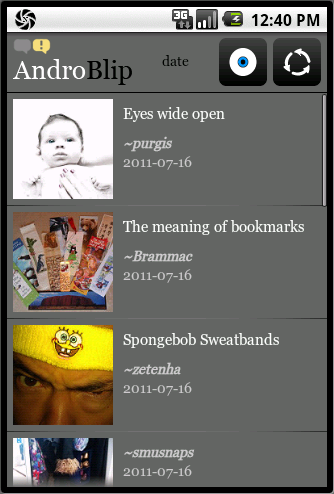
- Subscribe to journal (press menu while viewing an entry)
- Mark entry as favourite (press menu while viewing an entry) (Only available for blipfoto full members).
- Autosave. Saving title, description and tags of an upload when leaving the screen without uploading.
- (android) Notifications. Notify you of new comments and notifications in the status bar, as well as on the main screen (confusing that the android feature is called “notification” and the blipfoto feature also :) ).
- Tags are now shown with entries on the exif/tags popup
You might notice that we are requesting an extra permission to “start on boot”. This is needed to restart the notification when you reboot, without you having to first start-up AndroBlip manually. If you have turned the notification off this will not do anything.
Updates
- Enforcing the limit on title-length (50 characters)
- Enforcing limit on amount of entries retrieved (90)
- Clickable tags showing search-result for that tag
Bugfixes
- Special characters work better now. (reported by ~dr )
- Force close bug reported trough google market fixed (NullPointerException)
- Retrieve-journal-after-clicking-on-a-name-bug that was reported on the site should be fixed (affectionately known as the “judith”-bug)
- Changed method to retrieve specific journals to something that actually makes sense
- Fixed padding on comments screen
- New about page
Have fun with this new release and please drop us a line to let us know what you think of it. If you have any requests for new features or encountered strange behaviour we’d love to hear it!
New project, new problems.
Another minor fix you “just need to know”. After some server changes (I moved my SVN installation for one), I decided to just start a new Eclipse project as opposed to ‘fixing’ the old one to the new SVN location.
My basic steps are somewhat like:
- Make a new Android project with some fake settings
- Connect to SVN
- Team->revert the hell out of it
Most of the time this works well.
The problem:
There seems to be a class missing, but there isn’t:
After having all the files, the application still doesn’t work. It compiles and goes to the emulator nicely, but then this happens:
ERROR/AndroidRuntime(287): java.lang.RuntimeException:
Unable to instantiate activity ComponentInfo{packageNameGoesHere}:
              java.lang.ClassNotFoundException:
packageName.ClassName in loader
              dalvik.system.PathClassLoader@44e7a8a8
And:
Caused by: java.lang.ClassNotFoundException:
                   packageName.ClassName in
                   loader dalvik.system.PathClassLoader@44e7a8a8
           at dalvik.system.PathClassLoader.findClass
                   (PathClassLoader.java:243)
No fun at all.
This error is quite obvious: it calls a certain class that cannot be found. In this case it was the class of my main activity. Not a thing that would be easily to miss. It was there in the source of course, no errors in sight, etc, but it still didn’t register as being there. This is of course a warning sign that something is wrong with your building path. But what?
The Solution
For some reason Eclipse had decided that –as opposed to every sane default– my /src folder didn’t need to be in my build-path. Easily fixed if you this is the problem:
- Open the build-path (right-mouse on the project -> build-path -> configure build path, or project-properties-> Java Build Path)
- Click the Source tab.
- Make sure your /gen and your /src paths are listed there.
- While you’re at it, if you use google analytics, make sure that libGoogleAnalytics.jar is present in the libraries tab!
Scope
Because I was trying Ubuntu 10.10 on my laptop, I had to install a new development environment. Not too much work: I’ve used the installing instructions from Google [1].
This basically boils down to:
- Install Eclipse (I just used the ubuntu software center for this).
- Download Android SDK and unpack it.
- Install Android ADT plugin for Eclipse using the Eclipse install-software feature [2]
- Set the path to the android SDK / tools (step 2) in the Eclipse preferences.
I didn’t install the JDK, because it was on my machine by default. I assume the package manager has that, but I’m not sure. Now I’m all happy with my new toys, installing Subclipse for SVN, getting my source, and coding away. Then the trouble started :)
Symptoms
It seems that I couldn’t start any Android Virtual Device (AVD). I made a new run configuration, but it didn’t start. Instead I got an error, stating:
‘Launching android’ has encountered a problem.
An internal error occurred during : “Launching android”.
Clicking “details >>” produces an extra line:
Path for project must have only one segment
And, for full disclosure, the complete log-entry included trailing this post.
Cause & Solution
It seems that this rather cryptic message means nothing more in my case than “please enter a name and project for your run configuration”. I did have a “name”, but left the “Project” field empty. Entering a value in the ‘project’ (the “AndroBlip” you see next to ‘browse’) fixed it. Sources seem to indicate that the same error is produced if you don’t enter a value in the ‘name’-field.
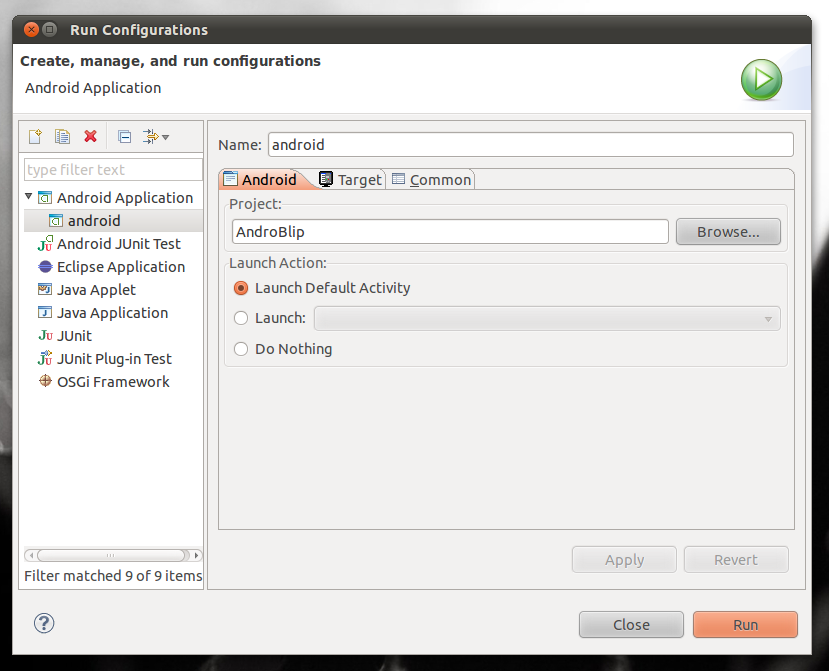
Screenshot
References
- http://developer.android.com/sdk/installing.html
- https://dl-ssl.google.com/android/eclipse/
- http://stackoverflow.com/questions/4961151/android-path-for-project-must-have-only-one-segment
Complete error log
!ENTRY org.eclipse.core.jobs 4 2 2011-02-20 12:12:00.397!MESSAGE An internal error occurred during: “Launching android”.!STACK 0java.lang.IllegalArgumentException: Path for project must have only one segment.at org.eclipse.core.runtime.Assert.isLegal(Assert.java:63)at org.eclipse.core.internal.resources.WorkspaceRoot.getProject(WorkspaceRoot.java:181)at com.android.ide.eclipse.adt.internal.launch.LaunchConfigDelegate.getProject(Unknown Source)at com.android.ide.eclipse.adt.internal.launch.LaunchConfigDelegate.launch(Unknown Source)at org.eclipse.debug.internal.core.LaunchConfiguration.launch(LaunchConfiguration.java:853)at org.eclipse.debug.internal.core.LaunchConfiguration.launch(LaunchConfiguration.java:703)at org.eclipse.debug.internal.ui.DebugUIPlugin.buildAndLaunch(DebugUIPlugin.java:866)at org.eclipse.debug.internal.ui.DebugUIPlugin$8.run(DebugUIPlugin.java:1069)at org.eclipse.core.internal.jobs.Worker.run(Worker.java:55)
Google launched their Android Market on the web two days ago. What I personally like is being able to browse through my installed Android apps on my computer and find new ones to install. You can buy apps on the web and they wil automatically be installed on your phone. There is also the option of leaving a user review for an app.
Of course we immediately looked to see how AndroBlip was featured there! :-)
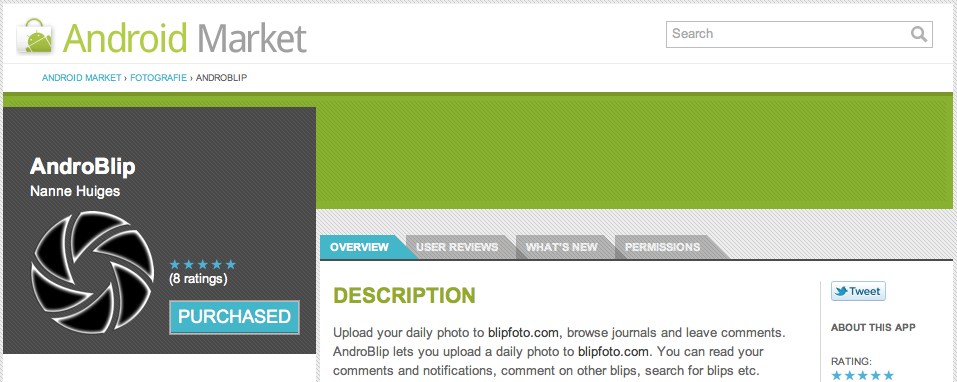
Hopefully, this new way of finding apps for Android will make it easier to leave comments or suggestions for our app. We hope to see some user reviews soon!
There is also an option for us to add video’s to the app description, like for example Winamp did on their Market page. Suggestions for making a (fun?) video are welcome!


Recent comments